 Fairgo
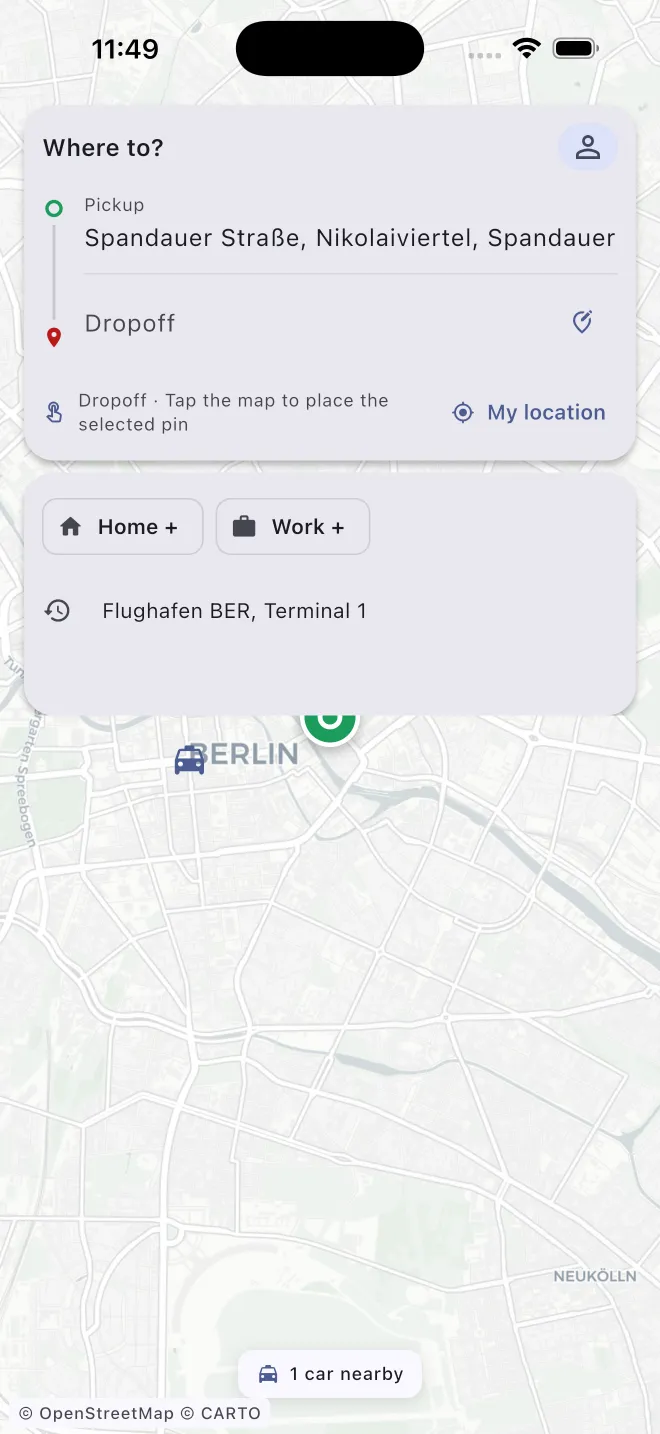
Where your money goes
Fairgo never holds your fare. You pay the driver; the driver pays us.
-
You pay the driver, directly
Cash or card, depending on what your market allows. Where card payments are available they settle to the driver's own payment account. The fare does not pass through a Fairgo account at any point.
-
You are charged no fee
No booking fee, no service fee, no separate platform charge on the rider's side. A tip, if you leave one, goes to the driver in full.
-
The driver pays Fairgo 1% — or nothing
A technology service fee of 1% of the fare, charged to the driver and never to you. It is not deducted from the trip: it accrues, and comes out of the driver's next card payment. Where there is no card payment to take it from — Morocco, and everywhere our payment partner does not operate — the fee is zero and the driver keeps 100% of the fare and 100% of every tip. See how Fairgo works.
That is the whole commercial model. Because we are never holding the money, there is no float, no payout delay and nothing for us to withhold.
What it actually looks like
Real screens from the apps that were submitted to the App Store, captured from the running build against a real backend. No mock-ups, no renders, no invented numbers.
-
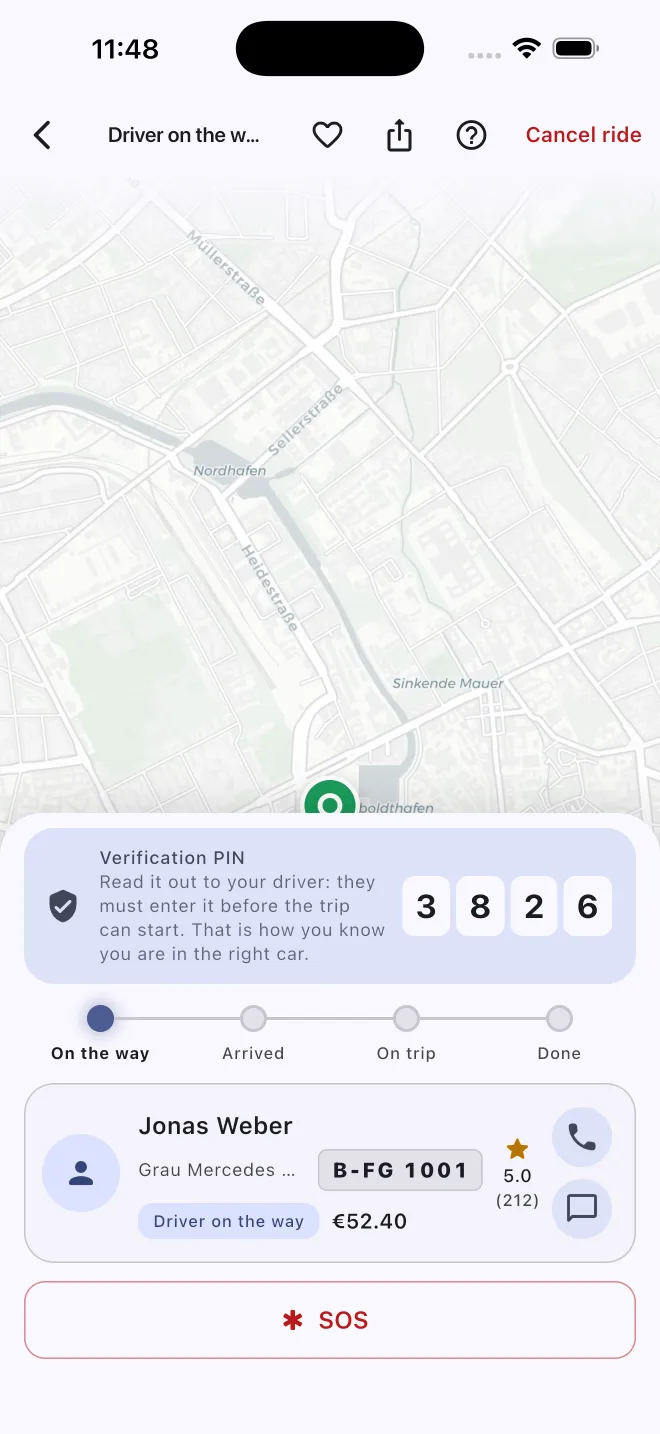
Following the driver, with the PIN that starts the trip.
-
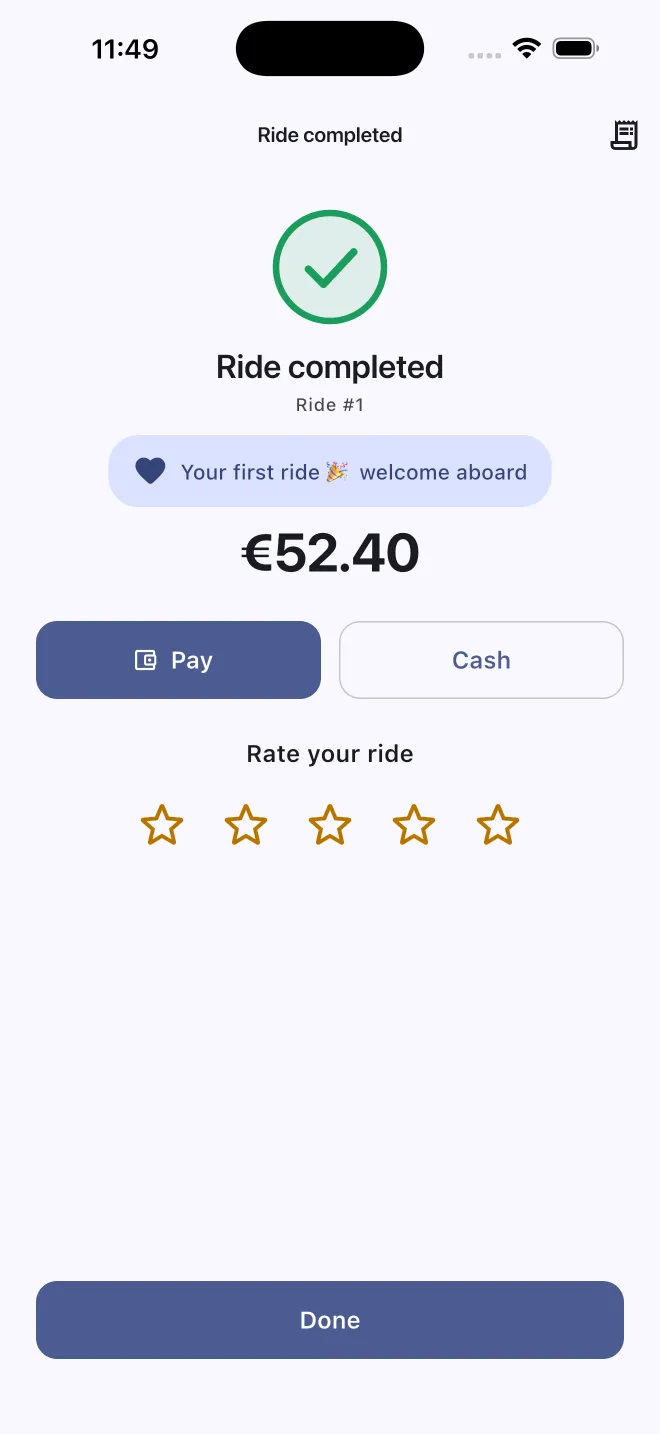
The fare at the end — and the tip, which is the driver's.
-
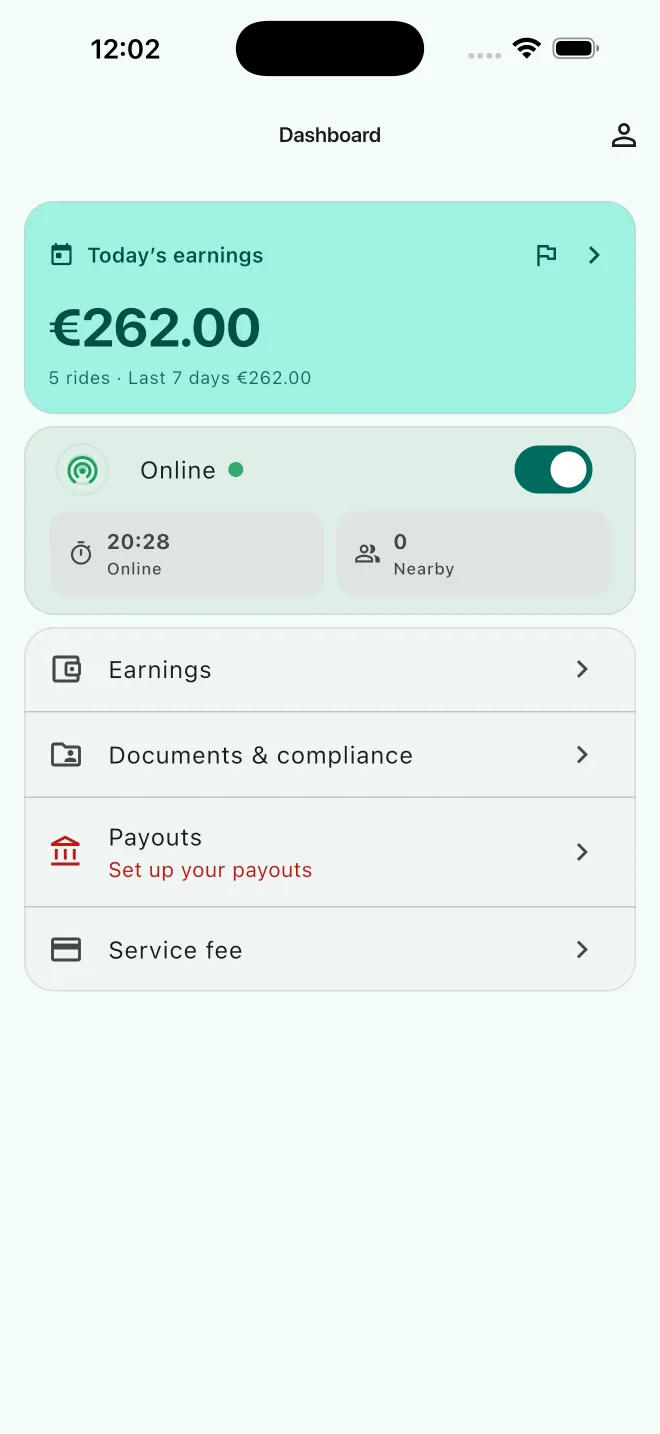
What a driver sees: the money, and the switch.
Ride with Fairgo
Know the price before you book. Follow your driver on the map. Pay the driver directly.
-
1. Set your pickup
Open the app and it finds you. Type a destination and you see the price before you commit. Where drivers set their own tariff, that is a range until you are matched — then it is your driver's price, and it does not change when you arrive.
-
2. Match and follow
You see the driver, the car and the plate, and watch them approach in real time. Share the trip with someone if you want them to know you arrived.
-
3. Pay the driver
Cash, or card where the market supports it — some markets are cash only, and the app says which methods yours takes before you book. A PIN confirms you are getting into the right car.
-
What you are not charged
No booking fee, no service fee, no surge dressed up as something else. The 1% is the driver's cost of using Fairgo, and it never reaches your fare.
Drive with Fairgo
Keep at least 99% of every fare and 100% of every tip — and 100% of both in Morocco, where we charge nothing at all. Nothing is ever deducted from a trip. Where the fee applies it comes out of your next card payment, and never more than 10% of any single one, so a balance built up on cash rides draws down over several trips instead of in one bite.
| Typical platform (25%) | Fairgo (1%) | Fairgo in Morocco (0%) | |
|---|---|---|---|
| Fares collected | 100.00 € | 100.00 € | 100.00 € |
| Platform takes | 25.00 € | 1.00 € | 0.00 € |
| You keep | 75.00 € | 99.00 € | 100.00 € |
-
Decline without penalty
Turning down a trip costs you nothing and is not recorded against you. No acceptance rate, no hidden scoring.
-
No exclusivity
Run Fairgo alongside any other platform. You are an independent contractor, and the product is built to keep it that way.
-
Money goes straight to you
Where card payments are available, they settle to your own payment account; cash never touches us at all. Fairgo never skims a trip: where the fee applies it is taken from your next card payment, capped at 10% of that payment.
-
Verified, then live
Every document your market requires is read and checked — name, expiry and document type — before your account goes active. Anything that does not pass cleanly goes to a human. That is what makes the market worth being in.
Safety
- PIN confirmation — the rider gives the driver a code before the trip starts, so nobody gets into the wrong car.
- Share your trip — send a link so someone you trust knows you are on your way.
- Emergency button in-app — one tap dials the emergency number the app holds for the market you are in, not a generic international one.
- Verified drivers — every document a market requires is checked before the account can go active, and an expired document does not pass.
- Two-way ratings — you see your driver's rating and photo before they arrive; they see yours. Both are earned trip by trip.
- Contact that expires — you can call or message your driver while the trip is live and for two hours after it ends. After that neither of you can reach the other's number through Fairgo, so an old trip does not stay a working phone number.
Where Fairgo operates
Fairgo opens one market at a time, and only after the local rules for private-hire transport have been checked. Where we are not live, the apps say so plainly instead of pretending.
The app itself is the authoritative answer, and it is always current: it resolves your market the moment it launches and tells you whether Fairgo operates there. A market is live only when it has been signed off, so this page can lag reality by a day — the app cannot.
The rule is default-deny, and it runs on the server rather than in the app. A region is closed unless somebody has explicitly opened it, and the block is applied when a driver goes online and again when a ride is created — so a modified app, or a bug in one, cannot open a market that has not been signed off. That also means a country being prepared in our data is not the same as a country being open: pricing rules, payment methods, document lists and the emergency number are wired for many more markets than are live.
We are early, and the honest shape of that is: few markets, opened deliberately, rather than a map covered in pins. If Fairgo is not open where you are, the app will say so on the first screen instead of letting you request a ride nobody can take.
Live today
These are the markets that were open on 18 August 2026:
- Czechia
- Finland
- Germany
- Morocco
- Netherlands
- Peru
- Spain
- Sweden
Every other country is closed. That date is there on purpose: this list is written down on the day of a deploy, and a market can open or close after it. The app reads the same data live, so where the two disagree the app is right.
How Fairgo works
Fairgo is a marketplace, not a taxi company. We do two things: match a rider with a nearby licensed driver, and get out of the way of the money. Everything below follows from that.
Booking a ride
Open the app and it resolves which market you are in — that matters, because the rules for private-hire transport differ by country and city, and features change to match. Enter a destination and you see a price before you commit, calculated from distance, time and the market's pricing rules. In driver-priced markets — the model Fairgo prefers, because a driver who sets their own tariff is genuinely independent — each driver has their own rates, so before you are matched the app shows a range rather than a single number, and the exact price is the tariff of the driver who takes the trip. In platform-priced markets the price is computed centrally and any surge is shown to you with its multiplier rather than folded in quietly. In a few markets the law requires a taxi meter, and there the meter decides — the app says so instead of inventing an estimate.
Once you book, dispatch offers the trip to the nearest available driver for 45 seconds. If they do not answer, it moves to the next one. If nobody can take it, the request ends and tells you so rather than spinning indefinitely.
During the trip
You see the driver's name, photo, vehicle and plate, and follow the car on the map as it approaches. Before you get in, you give the driver a PIN — that is what stops anyone getting into the wrong car, and it is the single most effective safety feature we have. You can share a link so somebody knows you are on your way.
Paying
Card or cash, depending on what the market allows. Card payments settle to the driver's own payment account through Stripe — the money never passes through Fairgo, so there is no float, no payout delay and nothing for us to withhold. Cash simply changes hands. Stripe does not operate in every country, and where it does not, Fairgo is cash only: the app shows you which methods your market actually supports rather than promising a card sheet that cannot open.
What a ride costs
The fare is the fare. There is no booking fee, no service fee and no separate platform charge on the rider's side. A tip, if you leave one, goes to the driver in full — it is never part of what the 1% is calculated on. The only money Fairgo earns is a technology fee of 1% of the fare, charged to the driver, which is why the fare does not need to carry a commission.
How it is collected. There is no invoice and no per-trip deduction. The 1% accrues on the driver's account, and the next time that driver takes a card payment it comes out of that charge as Fairgo's share of it — that trip's own 1%, plus as much of any balance built up on cash trips as the cap allows, and never more than 10% of the payment. Across all their fares it still comes to 1%, and never more.
Where the fee is not charged at all. Collecting it needs a card payment, and a card payment needs a payment partner that operates in the driver's country. In markets where none does — Morocco, and everywhere Stripe does not reach — there is nothing to take the fee from, so the rate is set to zero rather than accrued against a driver who could never be charged it. There the driver keeps 100% of the fare and 100% of every tip, their app shows nothing owed, and Fairgo earns nothing on the trip. We would rather say that plainly than quietly run up a balance.
It is deliberately dull, and that is the point. Platforms that take 20–30% have to keep the rider's price high enough to cover it. At 1% we do not.
Driving with Fairgo: the details that matter
What you keep
99% of every fare and 100% of every tip. The 1% is never skimmed off a trip, so your day's takings are your day's takings: it accrues quietly and is settled out of your next card payment, capped at 10% of that payment. On 1,000 in fares you keep 990; on a platform charging 25% you would keep 750. Over a working year that difference is not a rounding error, it is a salary.
In a market where our payment partner does not operate there is no card payment to settle it from — so we do not charge the fee at all. There you keep 100%, and your earnings screen shows no balance owed, because there is none. That is the situation in Morocco today. If it ever changes, it changes for rides booked afterwards; nothing is charged retroactively.
How you get paid
Where Stripe operates in your country, card fares settle directly to your own Stripe account — you are the merchant of your own rides, and the rider's money never enters a Fairgo balance. Where it does not, Fairgo runs on cash, which is yours the moment it is handed over. Either way there is no weekly payout cycle to wait for, because we are never holding the money in the first place.
Independence, in practice rather than in a press release
You can decline any trip without penalty, and declines are not counted against you: there is no acceptance rate and no hidden score. There is no exclusivity, so running Fairgo alongside another platform is expected, not tolerated. A driver whose account is suspended is told so plainly in the app and can appeal by writing to us. These are product choices, not favours — a platform that penalises refusal is exercising control it should not have over an independent contractor.
Getting approved
You need to be legally entitled to carry passengers for hire where you drive, and to supply the documents that market requires. The list is set per market rather than guessed: in Morocco it is your national identity card (CIN), your driving licence, the vehicle's carte grise and your agrément or taxi driver's card. Markets treated as platform-organised transport also require a professional operator card, company registration and commercial insurance — none of those markets is open today.
You photograph each document in the app. It is read automatically and checked against your account — the name has to match, the expiry has to be in the future, and the document has to be the type you said it was. Anything that does not pass cleanly is sent to a human instead of being waved through, and your account only goes active once every required document has been approved. That is slower than a form that trusts you, and it is the reason riders can trust who turns up.
Safety, and what we actually do about it
Most of the risk in private-hire transport is concentrated in two moments: getting into the car, and being alone in it. Our safety features target exactly those.
The PIN is checked by the server, not the app, and a trip cannot start without it. The driver never sees the number — they have to be told it — which is what makes it worth anything. Trip sharing gives someone you choose a link that shows the trip while it is running and goes dead the moment it ends, so it cannot become a way to follow you afterwards; it never exposes your phone number. The emergency button dials the number the app holds for the market you are physically in, not a generic international one that would waste the seconds that matter. Drivers' documents are verified before activation, with anything doubtful escalated to a person, and an expired document does not pass. Riders and drivers rate each other, and each sees the other's rating before the trip starts.
We are equally clear about what we do not do. Neither app records audio: they do not ask for microphone access at all, so there is nothing to switch off. The rider app does not track you in the background — it has no background-location capability, so it cannot. We do not share your data with advertisers, and neither app contains an advertising SDK.
And we will not pretend to be something we are not. Fairgo is a small operation, without a 24-hour safety room. What we can honestly promise is that a report reaches a person who can act on it and that we will tell you what we did about it. If you are in danger, call the emergency services first — the button in the app is there to make that one tap.
If something goes wrong
Nobody chooses a ride-hailing app for the day it works. Here is what actually happens on the day it does not.
Nobody accepts the trip
Each offer sits with one driver for 45 seconds, then moves to the next. If no driver in range takes it, the request ends and the app tells you so — it does not spin forever, and you are not charged for a ride that never happened, because nothing has been charged at any point before the trip.
You change your mind
Cancelling is free until two minutes after a driver has accepted. After that, a late-cancellation fee of 25% of the fare is recorded on the trip — the app tells you the amount before you confirm, never afterwards. That is compensation for a driver who is already on their way to you, not a Fairgo charge; we take no part of it. A driver who cancels is never charged anything, deliberately.
The driver does not turn up, or the price is wrong
Because the money goes from you to the driver and never through us, we cannot quietly refund you from a balance we are holding — there isn't one. What we can do is find the trip, put the facts in front of both of you, and help settle it with the driver. Email us with the approximate time and pickup address and we will start there. On a cash ride, nothing has been taken from you at all.
You felt unsafe
Call the emergency services first — the app has a button for it. Then tell us, with the trip and what happened. A driver's account can be suspended while we look into it, and account decisions follow written rules and can be appealed, in both directions.
You want your data, or you want out
Account → Delete account, in either app. Your personal data is erased and your login is closed. The records the law requires us to keep — invoices, and the trip record your counterparty also has a right to — are kept and no longer point at a person. See the privacy policy for what that means precisely.
Get the apps
There are two: Fairgo: Book a Ride for riders and Fairgo Driver for drivers, both for iPhone and iPad.
Both apps are in English, French, Spanish, German, Portuguese and Arabic, and they follow the language your phone is set to.
Android is not released. It is being prepared, and there is no date we can stand behind. If you are on Android today, Fairgo is not yet something you can use — we would rather write that than take your email against a promise.
You sign in with a one-time code sent to your phone number, in both apps. On iPhone and iPad Sign in with Apple is offered as well, and you can hide your email address when you use it; we then only ever see Apple's relay address. A rider account is required to book — there is no guest ride.
Neither app is on the App Store yet. Both have been submitted and neither is available to download today, so there is no link on this page to give you and no launch date we can promise. To hear when they land, email hugomoriceau@icloud.com.